Monica Rico is a CantoMundo Fellow and Macondista who grew up in Saginaw, Michigan. She is an MFA graduate of the University of Michigan’s Helen Zell Writers’ Program, winner of a Hopwood Graduate Poetry Award, a 2021 Ballard Spahr Prize for Poetry finalist, and 2021 winner of the Levis Prize in Poetry, selected by Kaveh Akbar.

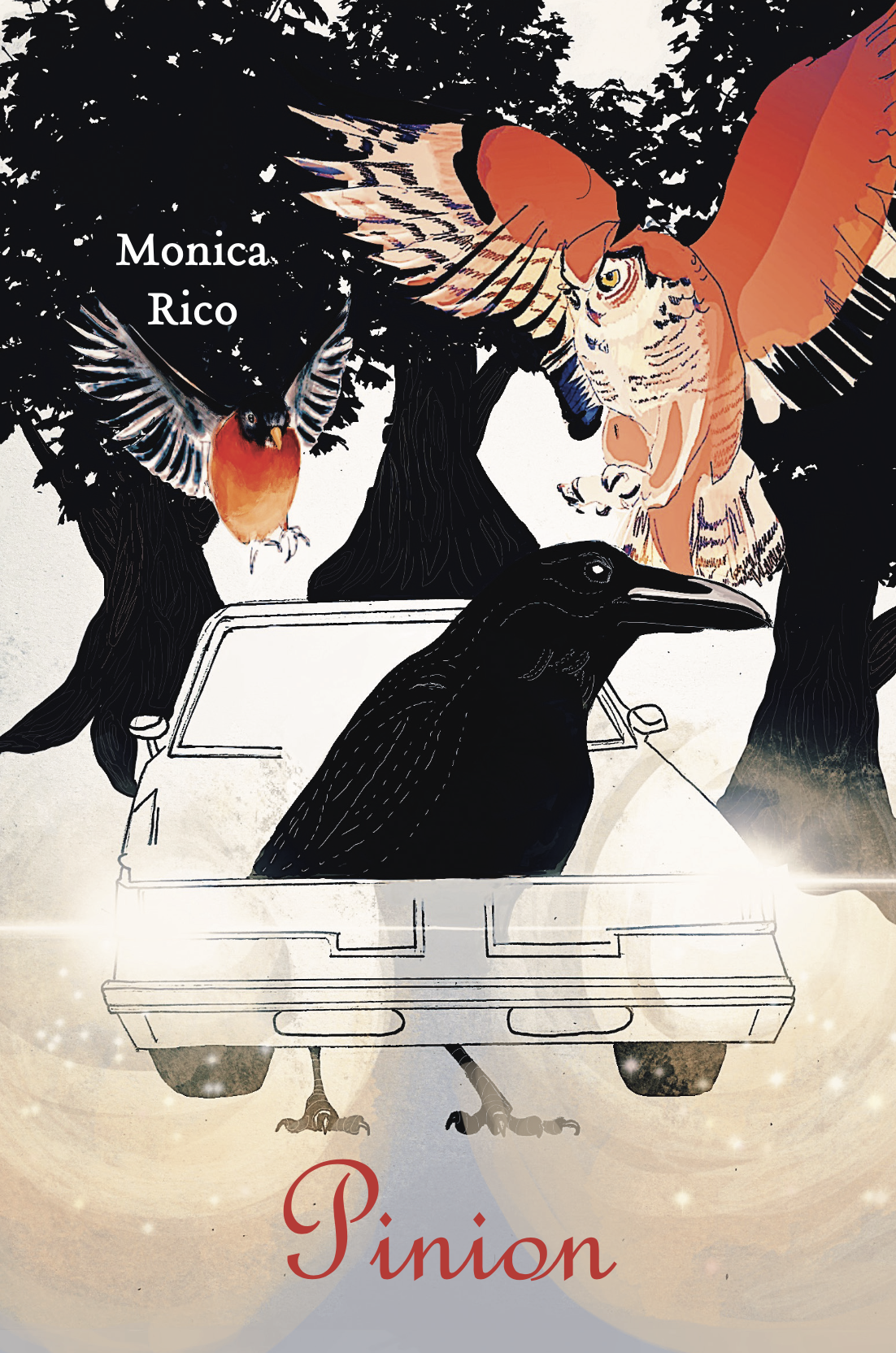
“I / step into the kitchen because I can / no longer smell the lilac / bush my father cut down,” Monica Rico writes in the opening poem of her astonishing debut collection. Deeply invested in unearthing women’s identity from a patriarchal family structure, these pages catalog life beside loss, the truth of cruelty accompanied by a defiant vitality. Here, where the declaration “I can” is modified to “I can / no longer,” Rico untangles the paradox of love, how a persistent absence keeps the missing object present, asserting itself through grief and memory; the scent of lilac lingers precisely because we cannot smell it anymore. The dual meaning of “pinion” scaffolds this collection, which considers Rico’s family and their experiences in the context of her grandparents’ immigration to the USA from México, American racial capitalism, and the mass migration catalyzed and necessitated by Western colonialism. “Pinion” in noun form refers to a bird’s outer flight feathers; in verb form, it means to bind or sever this part of the wing to hinder flight. Bound up in this word, then, is a thing and its destruction – a possibility and a thwarted hope side by side. Rico creates her own motifs to write a representative genealogy, approaching her family as an ornithologist: across poems, her grandfather (who worked at General Motors) appears as an owl, her grandmother figures as a robin, and the American project shows up in the eagle’s warped beak and surveilling eye. A field work of restoration, these poems compose a personal history and a deconstruction of global capitalism as articulated through an encyclopedia of birds. From the chaos of our flawed world, Rico salvages an enduring hope, reminding us that “a broken / song like an ugly duckling isn’t ugly / but unique, and stands out like the flightless / dodo who trusts because it is too awful not to.”
Winner of the Four Way Books Levis Prize in Poetry
Inside Monica Rico’s Pinion, centuries grind together inside a pinch of yeast, across slain soldiers and a pigeon dusted with coal. It’s such a dazzling braid, illuminating (and complicating) civic histories with familial mythologies, then vice versa. Rico’s prodigious gift for form includes knowing when to rupture it, like a virtuoso punctuating a masterpiece by smashing apart her instrument onstage: “Mi’jo, mi’ja, // mi vida, petunia. / I’m trespassing once // I stop moving.” Pinion introduces us to a major new lyric voice—Rico absolutely soars.
—Kaveh Akbar, judge
“The lines bring to mind the kind of working-class attention that Philip Levine brought to his poems about Detroit, but with a different attention to synthesis. Here, everything that feels so physical, present, and muscular in the syntax also makes us see the weariness of something constructed to be shipped or driven somewhere else. The migrations of birds (for survival) and of people (for work) intersect, guiding the reader toward greater empathy.”
— Steven Leyva on Pinion, Washington Independent Review of Books
All the Shiny Knifes, a Poetry Off the Shelf discussion on cooking, grunt work, and the heat at General Motors — Monica Rico and Helena de Groot.
Major Jackson reads “Ferment” on The Slowdown, episode 1078.
Pinion

Pinion: The wing. To restrain by binding the arms. A gear. Within a single word—the title of this opulent collection—the inferences are packed like feathers around bone… Like Rivera’s murals and Kahlo’s paintings, Rico’s poems exist in both allegory and the real. Her crows, owls, robins, and cardinals are real birds charged with the electricity of symbolism.
— Diane Seuss, author of frank: sonnets
Monica Rico is the poet we need now, and this book will be savored by all who read it—at this moment, and far into the future… This poet’s talent arrives to us seeming miraculous, effortless, and fully formed. A remarkable collection, this is poetry that is essential, powerful, and unforgettable.
— Laura Kasischke
“Evoking the splotches and stains on the sleeves of her chef whites, Rico’s poems are brilliantly tactile, giving new significance to elasticity as a means to stretch across the lines between home and professional cooking…”
— Daniel E. Bender and Signe Rousseau, for the Gastronomica Editorial Collective, Toronto and Cape Town, September 2021

The Annotated Nightstand: What Diane Seuss is Reading Now and Next
Featuring Frank O'Hara, Evie Shockley, Monica Rico, and More
Selected Publications
- Tomato & LettuceThe Atlantic
- Prompt 281. Butterfly, Flying Home & the poet Monica Rico on superheroes and song lyricsThe Isolation Journals
- The Owls of Saginaw8-poem anthologia, Guernica
- A Lesson from my Father about ElectricityPoem-a-Day, selected by Diane Seuss
- Five Things BorrowedWildness
- Get Out of My Houseecotone
- Two poems & a Field NoteLife List by Poetry Northwest
- My God Has the Head of a Vulture - Two poems Electric Literature
- American CrowBeloit Poetry Journal
- Feeding RitualsThe Missouri Review
- Cortés Burning the AviariesThe Nation
Awards, Fellowships, and Residencies
- Pushcart Nomination 2023 — Constellation, Third Coast
- UNCW Writers' Week Speaker 2023
- Finalist Best New Poets 2023
- Nominated Best New Poets 2022
- Winner 2022 Moveen Prize in Poetry
- Semi-Finalist 2021 Adrienne Rich Award for Poetry
- Winner 2021 Levis Prize in Poetry
- Finalist 2021 Ballard Spahr Prize for Poetry
- Semi-Finalist 2020 92Y’s Discovery Poetry Contest
- 2020 Frontier Poetry OPEN longlist
- Goodhart Artist Residency
- CantoMundista
- Hopwood Graduate Poetry Award
- Finalist 2019 Black Warrior Review Poetry Contest
- Macondista